Ancient Bog Oak: A Material Thousands of Years in the Making
There are few materials in the natural world quite as extraordinary as ancient bog oak.
Long before it finds its way into the hands of a craftsman, this remarkable wood has already undergone a transformation that can take thousands of years. Once part of a living oak tree, it may have stood in an ancient forest, fallen beside a river, and gradually disappeared beneath layers of sediment and water.
There, protected from much of the decay that ordinarily returns fallen trees to the earth, the wood remained.
Centuries passed. Landscapes changed. Rivers moved. Entire generations came and went.
And beneath the surface, the oak endured.
Today, ancient bog oak is among the most distinctive materials available to fine woodworkers, furniture makers, and bladesmiths. Its deep coloration, beautiful grain, and extraordinary history make it particularly suited to objects intended to be cherished for generations.
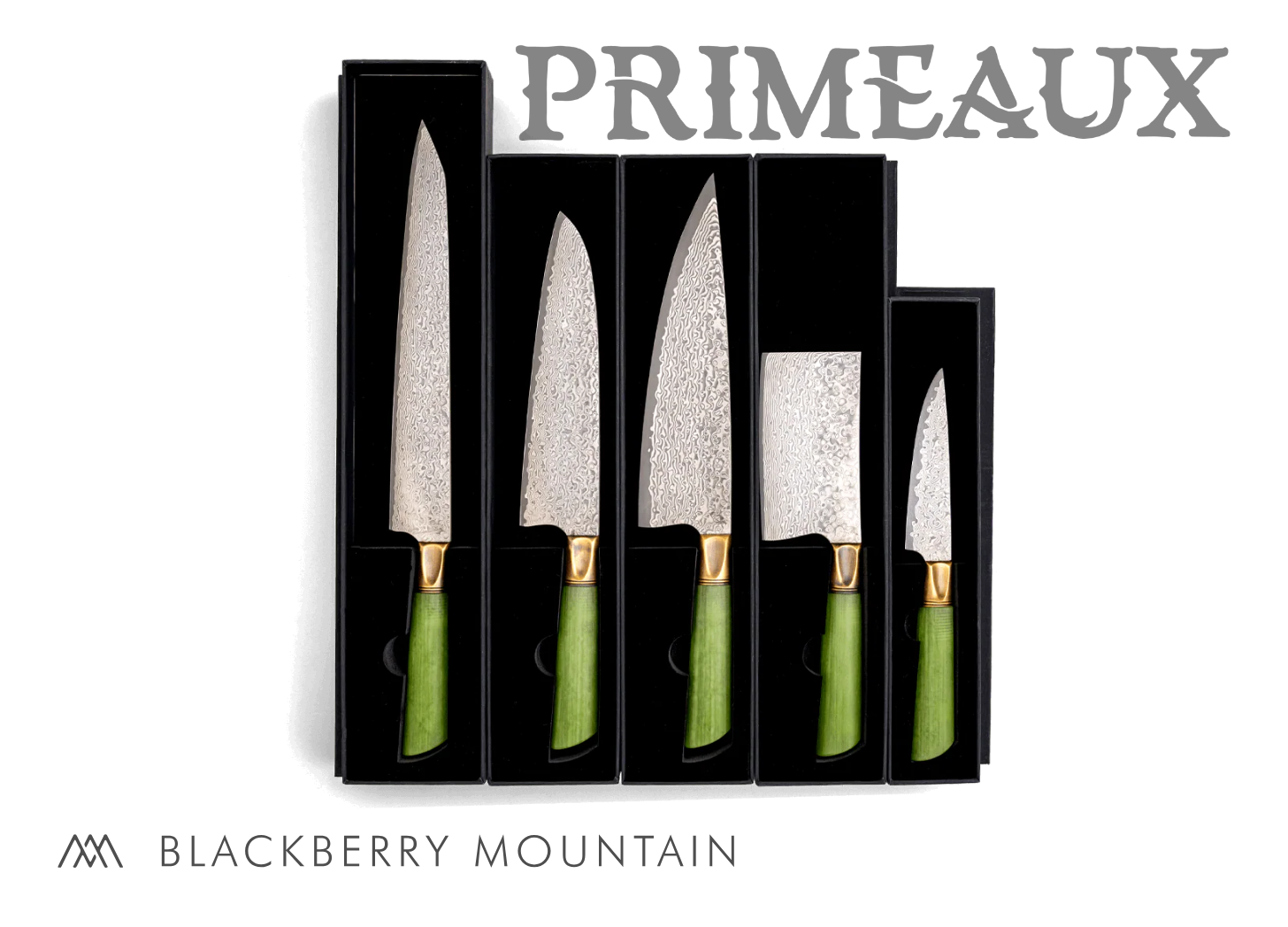
At Primeaux, we have the privilege of working with this exceptional material, transforming pieces of ancient timber into the handles of handcrafted kitchen knives.

Through radiocarbon dating, we have the opportunity to understand just how far into the past that history reaches.
The bog oak represented in our laboratory documentation was analyzed by a radiocarbon dating laboratory in Kyiv, Ukraine. The certificate, records a conventional radiocarbon age of 6450 ± 40 BP.
What Is Ancient Bog Oak?
Bog oak, also known as morta or abonos, is not a separate species of tree.
Rather, it is oak that has been naturally preserved beneath waterlogged soil, peat, or river sediment for an extended period.
Ordinarily, when a tree falls, fungi, microorganisms, insects, and the surrounding environment gradually break down the wood.
But under particular conditions, that process can be dramatically slowed.
When an oak tree becomes submerged and buried in an environment with very little available oxygen, the organisms responsible for much of the wood's decay are restricted. This allows portions of the original timber to survive for hundreds or even thousands of years.
Bog oak is sometimes described as subfossil wood: ancient timber that has undergone significant changes while retaining much of its original woody structure.
It is not the same as fully petrified wood, which has undergone extensive mineral replacement.
Instead, bog oak remains recognizably wood, complete with its natural grain, character, and evidence of the tree from which it came.
The Extraordinary Transformation of Oak
One of the most recognizable characteristics of bog oak is its color.
Freshly cut oak is typically golden brown or tan, with warm natural undertones. Ancient bog oak may range from muted brown and charcoal gray to an exceptionally deep, almost black finish.
These colors are the result of natural chemical processes that occur while the wood rests underground.
Oak contains tannins, naturally occurring compounds that can react with iron and other substances present in surrounding groundwater and sediment.
Over extended periods, these interactions can produce the rich, dark coloration for which bog oak is celebrated.
The result is not a conventional stain or surface treatment. The color develops through the wood's long interaction with its environment, and its appearance can vary considerably from one piece to another.
Some examples reveal subtle brown undertones. Others possess an almost ebony-like depth. The grain may appear quiet and uniform or beautifully expressive, depending upon the tree and the conditions in which it was preserved.
No two pieces share exactly the same history.
That individuality is part of what makes bog oak so compelling.
A Rare Discovery Beneath the Earth
Ancient bog oak cannot simply be harvested from a living forest.
Its existence depends upon a particular sequence of natural events.
A tree must first fall or become submerged, perhaps as a result of flooding, changes in a river's course, or the gradual development of wetlands.
It must then become buried in conditions that allow the wood to remain preserved over an exceptionally long period.
Only after its eventual discovery can the timber be recovered, carefully dried, assessed, and prepared for use.
Bog oak may be uncovered during excavation, agricultural work, or the recovery of material from rivers and wetlands. Each discovery offers a glimpse into a landscape that may have existed thousands of years before the present day.
The rarity of usable bog oak comes not only from the unusual circumstances necessary for its preservation, but also from the challenges of recovering and preparing ancient waterlogged timber.
Not every recovered piece is suitable for fine woodworking.
Finding material with the appropriate structural integrity, grain, and character requires considerable care.
Understanding the Age of Bog Oak Through Radiocarbon Dating
Perhaps the most remarkable aspect of working with ancient bog oak is that its age can be studied scientifically.
Radiocarbon dating, sometimes called carbon-14 dating, provides researchers with a way to estimate the age of organic materials, including ancient wood.
While a tree is alive, it exchanges carbon with its environment. Once that wood is no longer living, the radioactive carbon-14 it contains gradually decreases through a measurable process of decay.
By analyzing the carbon remaining in a sample, laboratories can estimate when the sampled wood was formed.
Because the amount of carbon-14 in the atmosphere has varied over time, radiocarbon measurements are calibrated to provide estimates of calendar age.
This means that the history of a piece of ancient timber can be investigated with far greater precision than appearance alone would allow.
Radiocarbon Documentation at Primeaux
We are especially pleased to have radiocarbon dating data associated with the antique bog oak used in our work.
For a material already distinguished by its beauty, this documentation adds another dimension: scientific insight into its extraordinary past.
The deep coloration and naturally preserved grain are remarkable in their own right. Knowing that the material's age can be supported by laboratory analysis makes its presence in a contemporary handcrafted object all the more compelling.
It is an uncommon opportunity to hold a piece of natural history, thoughtfully transformed into an object intended for daily use.
Why Bog Oak Is Prized in Fine Craftsmanship
Throughout the history of decorative woodworking, unusual and beautifully figured timbers have been selected for objects that deserve particular attention.
Bog oak holds a special place among them.
Its dark, sophisticated coloration offers an elegant alternative to more familiar hardwoods, while its distinctive grain gives each finished object an individual character.
The material has been used in fine furniture, decorative objects, turned pieces, and knife handles, where its natural beauty can be appreciated at close range.
Unlike wood that has been darkened simply to achieve a particular appearance, naturally preserved bog oak carries the visible results of its long environmental history.
The timber must be carefully prepared, and individual pieces vary in their physical properties. Its suitability for a particular object depends upon the condition and quality of the recovered wood.
For a bladesmith, selecting an appropriate piece is part of the craft itself.
Ancient Bog Oak in Primeaux Knives
In the workshop of bladesmith John Phillips, the relationship between blade and handle is central to the character of every knife.
Steel, wood, and metal are chosen not simply for their appearance, but for how they come together in a finished piece.
Ancient bog oak offers an especially beautiful contrast to patterned Damascus steel.
The intricate movement of the blade is balanced by the depth and restraint of the dark oak. A carefully finished bronze bolster introduces warmth between the materials, creating a composition that is at once traditional and contemporary.
There is something deeply satisfying about this pairing.
The steel has been shaped and finished by the hands of a living craftsman. The wood, by contrast, carries the effects of natural processes that began long before his lifetime.
Each has its own history.
Together, they form a knife intended to continue that story through years of use.
Made to Be Used. Worthy of Being Kept.
The finest handmade objects are not simply admired. They become part of our lives.
A kitchen knife may be used to prepare an ordinary weekday dinner, carve a holiday roast, or slice vegetables gathered from a garden. Over time, it becomes familiar through repetition, care, and use.
An ancient bog oak handle brings an unusual perspective to that experience.
What was once a living tree, then a piece of timber preserved beneath the earth, can begin an entirely new chapter as part of a functional object.
At Primeaux, we believe there is lasting value in making things with this kind of intention.
The material deserves careful selection. The knife deserves thoughtful craftsmanship. And the finished piece deserves a place in the hands of someone who will appreciate both.
Ancient bog oak reminds us that remarkable materials are not always created through human intervention.
Sometimes, nature has already done the most extraordinary work!
--
Scientific references
-
Institute of Making — Bog Oak: the natural preservation process and development of dark coloration.
-
Biogeosciences — Waterlogged Archaeological Oak: low-oxygen preservation, mineral accumulation, and iron–tannin chemistry.
-
Journal of Archaeological Science: Reports — Bog Oak Characterization: physical properties and an example of radiocarbon-dated ancient oak.
-
CIRAM Laboratory — Dating Ancient Wood: radiocarbon analysis of preserved timber.